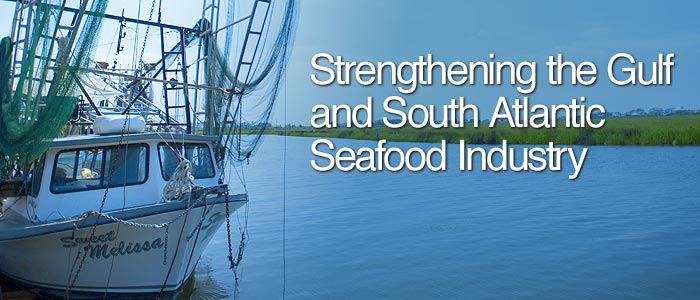
On Sunday morning, the scene at Shem Creek was unusually festive. Familiar shrimping boats like Wayne Magwood’s Winds of Fortune and Tommy Edwards’ Mrs. Judy Too were festooned in colorful flags as they readied themselves for the 25th Annual Blessing of the Fleet.
Meanwhile over at the Mt. Pleasant Waterfront Park, thousands of people were gathering on the pier for the town’s day-long celebration, which included live music, lots of food, and the 1 p.m. blessing of the fleet, which marks the beginning of the fishing season.
Mark and Kerry Marhefka of Abundant Seafood
On board Captain Mark Marhefka’s fishing boat, the Amy Marie of Abundant Seafood, were family and friends, including chefs like John Ondo of Lana Restaurant and Jill Mathias of Carolina’s.
Yummy fried chicken, courtesy of John Ondo
Marhefka and Matt Wrann had just put a fresh coat of paint on the boat, and his wife Kerry had made a delicious grouper salad (think tuna salad but with their own freshly caught fish), and everyone else brought a dish or two to share, which means there was a pretty amazing spread.
Mrs. Judy Too
The kids roamed the boat and sat up top on the wheelhouse, until the Department of Natural Resources pulled alongside and told the captain everyone had to get down. Apparently, the policing was much more strict this year, according to the Marhefkas. One shrimp boat had to turn back to Shem Creek because they had too many passengers.
Miss Paula
After a pleasant cruise of the harbor (the Amy Marie tops out at 7 knots), Marhefka got in the boat parade line and was blessed by the priest, which ended with a rousing cheer from the gathered crowds, both in the water and on the shore. After the blessing, the boats cruised back to Shem Creek where kids frolicked in the water and both dolphin and manatee were spotted. A fitting end to a magical day, which was marred only by the poorly done T-shirt design by Guy Harvey, who chose to depict a spot tail bass (or drum) and a spotted sea trout, two species that are sport fish and have not been open to commercial fishermen for decades.
Gulf continues PR push, while West Coast basks in bumper crop
Top Species: Wild shrimp
Gulf continues PR push, while West Coast basks in bumper crop
By Joanne Friedrick
April 05, 2012
The oil spill may be cleaned up in the Gulf following the BP disaster at the Deepwater Horizon platform, but those involved in the wild shrimp industry are still struggling to put questions about the safety of the seafood from that region to rest.
Florida was one of several states impacted by the oil spill and was on the receiving end of BP funds for testing and marketing its seafood. Martin May, management review specialist for the Florida Bureau of Seafood and Aquaculture Marketing in Tallahassee, says the state received $10 million from BP to test Gulf seafood and another $10 million for marketing. In the past, Florida marketed wild shrimp separately, but under its latest program all wild seafood is marketed together. “It’s in the vein of a rising tide floats all boats,” explains May.
In 2011, Florida landed 11 million pounds of shrimp worth about $22 million, he says. Although the state’s fishermen net many different species of shrimp, the majority are pink shrimp, says May.
Tests have shown no issues with the health of Florida’s shrimp population, he says, “but we’ve still combated a lot of negative press” especially when photos of the oil spill reappear. “We found as long as this had exited the news cycle, people weren’t concerned.”
Demand for shrimp is recovering, May adds, but probably not as quickly as had been expected. When there are scares in other food sectors, such as produce, the items affected tend to bounce back more quickly. With shrimp, he says, “it has been a slower return, although the economy could have had some impact on that.”
Some people who are watching their dollars may have eliminated seafood from their shopping list and haven’t yet started buying it again. Ewell Smith, executive director of the Louisiana Seafood Promotion & Marketing Board, says there are still some perception problems for shrimp and other seafood, especially in other parts of the country. So there is still a need to educate consumers about the safety of Louisiana shrimp.
Like Florida, Louisiana has received funds from BP for testing and promotion. As a result, Smith says the marketing budget has jumped roughly tenfold to $10 million.
The state’s offshore shrimp season gets under way in April and inshore in mid-May, he explains. There will continue to be events to highlight Louisiana shrimp, he says, such as the restaurant promotion that took place last September in New Orleans. Although geared toward all Louisiana seafood, wild shrimp was certainly a focal point. Now the plans are to expand the event to other parts of the state such as the north and central sections, Smith says.
September is typically a slower month for restaurants, but the promotion helped fill the seats, he adds.
One of the newest promotions involved a fitness challenge in which participants were urged to eat seafood two to three times a week. The event, which features shrimp in its promotional materials along with crab and red fish, was launched during Lent, but has year-round implications. “It helps people think about incorporating seafood into a healthy diet,” says Smith. Tied in with this promotion are a website, seafoodfitness.com, social media and a healthy recipe contest.
Another effort recently launched to support not just wild shrimp from Louisiana, but all Gulf fisheries, is eatgulfseafood.com. The marketing campaign was unveiled at last month’s International Boston Seafood Show and is a project of the newly formed Gulf Coast Seafood Marketing Coalition founded by the Gulf and South Atlantic Fisheries Foundation through a grant from the Gulf States Marine Fisheries Commission.
The Gulf restaurant trade has also taken on the task of rebuilding the market for wild shrimp. For a multi-unit restaurateur such as Ralph Brennan Restaurant Group in New Orleans, buying wild Gulf shrimp is important to the restaurant’s image.
Haley Bittermann, director of operations and corporate executive chef, only buys Gulf shrimp, using a number of purveyors to fill demand. Collectively, the restaurants
purchase about 30,000 pounds of shrimp each year, she says, ranging from U10s to peeled 40s and P&D 50s.
“Shrimp is a natural part of the diet in New Orleans,” she explains. The restaurant group operates Red Fish Grill, Jazz Kitchen, Ralph’s on the Park, café B, Heritage Grill and Café NOMA, and all typically serve brown or white shrimp, either fresh or frozen. At times, if she thinks the price will be going up, she’ll do a larger buy that is good for five months. This typically has given her a 40- to 50-cent difference on the market price.
The executive chef at each of the restaurants creates dishes and Bittermann’s job is to work with them to see that they are staying within the lines of the different concepts.
In another part of the South, Amber von Harten, fisheries specialist at the South Carolina Sea Grant Consortium in Columbia, S.C., hopes the warmer waters of this past winter will bring a greater yield to the state’s shrimp fishermen.
In 2011, the state’s shrimpers landed 2.9 million pounds, down from 4 million in 2010. A cold snap in January 2011 caused about 80 percent of the shrimp to die off, she says, so there wasn’t a white shrimp season. This year’s season is expected to open in mid-May, ahead of last year’s June start.
At the recent South Carolina Seafood Summit, von Harten says marketing was definitely a topic. Unlike some states, South Carolina doesn’t have a dedicated seafood marketing organization, but Sea Grant is trying to work with the state’s Department of Agriculture to promote shrimp and other seafood, especially since the Wild American Shrimp group isn’t operational anymore.
One of the ideas, says von Harten, is to get shrimp fishermen interested in participating in community-supported fisheries, which allow consumers to buy shares of the catch in advance, guaranteeing sales and a market for the shrimp.
Many of the state’s shrimpers participated for the past couple of years in the U.S. Department of Agriculture’s Trade Adjustment Assistance Program, she says, which allowed them to receive a $4,000 cash benefit for 12 hours of training, as well as an additional $8,000 if they developed a business plan with the help of a consultant.
The outlook on shrimp is entirely different moving from the South to the West: It was a banner year on the West Coast, according to Brad Pettinger, director of the Oregon Trawl Commission. Production of coldwater shrimp (Pandalus jordani) in 2011 was the fourth-highest on record, he says, reaching 48 million pounds, up from 31 million pounds in 2010.
Sizes and prices were also up in 2011, he notes, with shrimp selling for 51 cents a pound versus 35 cents the previous year.
Much of the improvement is related to ocean conditions, which were favorable and coincided with the mature lifecycle of the shrimp. “It’s a good time to be a shrimper,” he says.
Most of the catch off the Oregon coast is salad-size shrimp that is cooked and peeled and exported to Europe. But buyers from Asia are also interested, he says, especially in whole frozen shrimp, which may result in more product going into that market.
Pettinger acknowledges that some buyers are looking for larger shrimp, “but coldwater shrimp make up in flavor what it lacks in size.”
Contributing Editor Joanne Friedrick lives in Portland, Maine
Much has been reported about the Gulf’s physical and economic health since the Deepwater Horizon spill two years ago. Just this week, a report from the Arabic news network Aljazeera dredged up a raft of questions about deformities of Gulf seafood. Unfortunately, the story has taken flight and has been picked up by various other news outlets around the country. One has to wonder why alarmists want to tarnish the image of the Gulf of Mexico, because we’re not seeing sick shrimp, crab or fish like what has been portrayed. Sure, the natural and man-made disasters have left the Gulf Coast with a few scars and we understand the outrage over the environmental damage. If anyone should be upset, it’s the fishermen who work the waters every day. Working in the Gulf is not just our businesses; it’s where we come from and what we will pass on to future generations. So instead of looking back and fixating on isolated negatives, let’s look forward and acknowledge the positive momentum. There are three key points we’d like for you to take away: 1) when you eat seafood purchased from a local restaurant or retail store, you can be assured it meets the strictest of standards; 2) consumer demand for fresh, wild-caught seafood is on the rise; and 3) hardship can forge powerful partnerships, such as the Gulf Coast Seafood Coalition.
We can confidently say that Gulf Coast seafood is safe to eat. Our wild-caught seafood is among the most rigorously tested seafood in the world with the U.S. Food and Drug Administration, NOAA and state agencies continuing their monitoring and testing efforts. (Source: Fishwatch) In fact, the FDA says a person would have to eat 63 pounds of shrimp or crab, 5 pounds of oysters or 9 pounds of fish every day for five years would and they still would not exceed the level of concern. In their words, Gulf Coast seafood is passing tests with “flying colors.” So you can be assured that when you eat Gulf Coast seafood at your favorite restaurant or serve it up to your family, it’s safe, healthy and delicious.
The seafood community is on the upswing, with demand increasing for fresh, wild-caught Gulf Coast seafood. In fact, more than 70% of consumers say the oil spill isn’t affecting their consumption of seafood – especially those in the region. That’s significantly up from 30% after the spill. (Source: Gulf Coast Seafood Coalition 2011 Consumer Study) And that’s a good thing, because seafood is an economic engine that powers the entire region. With a combined income of $26.9 billion and more than $60 billion of sales influence nationwide, the Gulf Coast seafood community has a profound effect on the nation’s economy, producing 30% of the continental U.S. seafood. The fertile Gulf Coast produces 70% of the nation’s oysters, 69% of domestic shrimp and is a leading producer of domestic hard and soft-shell blue crabs.
The Gulf Coast Seafood Coalition is an incredible initiative and a positive example of collaboration. The Coalition was formed in 2011 as a result of a grant from the Gulf States Marine Fisheries Commission through National Oceanic and Atmospheric Administration (NOAA) and includes Texas, Louisiana, Mississippi, Alabama and Florida. Under the auspices of The Gulf & South Atlantic Fisheries Foundation, Inc., the Coalition has become a powerful group including tourism boards, restaurants, retailers, chefs, commercial fishermen, and charter boat sectors focused on coordinating marketing efforts and building business of wild seafood from the Gulf. The group was formally launched earlier this year at the Boston Seafood Show and is being applauded for working together to benefit all states and the entire Gulf Coast seafood community. Go to www.eatgulfseafood.com for the latest information on the Gulf Coast seafood community, news, recipes and more.
And yes, that’s the message: eat gulf seafood. In fact, instead of buying into negative reports and media alarmists, right now would be a good time for some fresh boiled shrimp . . . or a few tender soft shell crabs . . . and a dozen oysters on the half shell . . . or grilled snapper . . . or maybe . . .
Author:
Mike Voisin, seventh generation oysterman, President of the Foundation, Chair of the Gulf Coast Seafood Coalition which represents the five Gulf Coast states, and CEO of Motivatit Seafoods in Houma, Louisiana, one of America’s largest oyster processors
Shrimp Season Officially Under Way In South Carolina
by Grant Martin, The Island Packet
Posted: Thursday, April 19, 2012 at 2:48PM EDT
Monday marked the first day of the 2012 shrimp season in South Carolina, as the S.C. Department of Natural Resources lifted its restrictions on provisional trawling areas.
The areas are essentially pockets of open water about two to three miles offshore used by the DNR to gauge the shrimp fishery’s readiness for more extensive trawling closer to the coast.
And while the areas make up only about 25 percent of the general trawl zone — which the DNR might not make available for another few weeks — local shrimpers like Larry Toomer of the Bluffton Oyster Co. said they’re glad to be back on the water.
“The first day coming out is always a blessing,” said Toomer, adding the day’s haul was about 1,000 pounds of white shrimp. “It turned out better than I anticipated.”
Coalition Activities Highlighted Launch of New Website, Seafood Survey Results Panel and Flavorful Gulf Coast Seafood
TAMPA, FLORIDA – March 21, 2012 – The Gulf Seafood Marketing Coalition (Coalition) hosted an official kick-off event and launched its website – www.eatgulfseafood.com - at the 2012 International Boston Seafood Show. With more than 980 exhibitors and 18,000 plus buyers and sellers from all over the world, the show presented an excellent opportunity to introduce the organization as well as increase awareness of the seafood produced from the Gulf of Mexico.
“We began the day with a breakfast reception for approximately 125 guests including seafood buyers from prominent retailers and restaurants. Coalition members shared information about ongoing marketing efforts and guests were treated to Gulf Seafood Stuffed Breakfast Crepes with Mornay Sauce, a recipe that was created for the event,” said Mike Voisin, Chairman of the Coalition and President of the Foundation.
The Coalition unveiled its new website at the breakfast that launched to the public shortly after the reception. The site will be the official Gulf Coast source for consumers, media, seafood buyers and Gulf enthusiasts. The website includes: Gulf news, information about the Coalition, Gulf tourism, recipes, Gulf species, where to buy/find Gulf Seafood products, seafood safety, press announcements, and recipes. The site features information from all five Gulf States and links to each state’s seafood marketing organization.
The Coalition closed its launch day with a panel, Development of a Regional Seafood Marketing Coalition, the Gulf of Mexico Experience. Coalition members shared results from a nationwide consumer survey on seafood buying patterns. Overall the survey indicated that two out of ten consumers account for 46 percent of the consumption of seafood. Gulf seafood’s appealing qualities include healthy, variety, flavorful and comfort food. Speakers included: Chris Nelson - Bon Secour Fisheries; Joanne McNeely - Gulf and South Atlantic Fisheries Foundation, Inc.; Mike Voisin - Motivatit Seafood; Patrick Riley - Western Seafood Company Inc.; Robert Novotny - Bonefish Grill and Andy Furner - Trace Register LLC.
“All attendees expressed excitement and support for the launch of the Coalition and the website,” said Chris Nelson, Vice Chairman of the Coalition. “We had great conversations with industry leaders and we’re looking forward to building on the positive momentum for Gulf Coast Seafood.”
For more information about the Gulf Seafood Marketing Coalition please contact Judy Jamison, Executive Director, Gulf & South Atlantic Fisheries Foundation, Inc. at judy.jamison@att.net - 813-286-8390 or Joanne McNeely at mcneely.joanne@gmail.com - 850-224-1129.
About Gulf Seafood Marketing Coalition
The Coalition provides a framework for the seafood community to coordinate marketing efforts among the Gulf States with emphasis on working with tourism boards, restaurants, retailers and chefs. The Gulf & South Atlantic Fisheries Foundation, Inc. is coordinating the Gulf Seafood Marketing Coalition through funding provided by the Gulf States Marine Fisheries Commission’s (NOAA Award #NA10NMF4770481). For more information, please visit www.eatgulfseafood.com and follow the Coalition on Facebook at Gulf Coast Seafood and Twitter at @eatgulfseafood.
About Gulf & South Atlantic Fisheries Foundation, Inc.
The Foundation is a private, regional nonprofit research organization with a general membership and Board of Trustees representing a wide spectrum of the commercial fishing industry throughout the southeast U.S. Through the Foundation, the commercial seafood and fishing industry can collectively identify industry needs, and address those needs through appropriate research and other activities. Representing the nine-state region from Virginia to Texas, the Foundation has sponsored more than 600 fisheries related research projects.
BOSTON — Fishermen from California to New England plan to rally for their struggling industry in Washington next week with an election year message for Congress: helping the fishing industry will save jobs.
Organizers expect a roster of lawmakers to speak before about 5,000 commercial and recreational fishermen in a park next to the U.S. Capitol on Wednesday.
The crowd is expected to include fishermen from all the Atlantic coast states plus Alaska and California.
They represent diverse interests who chase a mix of species and haven't always agreed. But Jim Donofrio, head of the Recreational Fishing Alliance, a rally organizer, says they share concerns that federal regulators are using flawed science to make cutbacks that are killing fishing jobs around the country.
In an election year when jobs are a dominant issue, Donofrio said he hopes the rally's calls reach new corners on Capitol Hill and prompt action on legislation fishermen believe can help.
"This election is being defined by jobs right now, and this is a jobs issue," Donofrio said.
Sam Rauch, head of the National Oceanic and Atmospheric Administration fisheries arm, agreed fishing jobs are a key concern. But he said the recent numbers on fishing jobs show progress. According to the most recent statistics, the number of fishing-related jobs in the U.S. went from 1 million to 1.2 million between 2009 and 2010.
But Rauch said he knows the growth hasn't been felt everywhere. In New England, for instance, fishermen are facing a possible fishery collapse in 2013 because of the too-slow recovery of cod in the Gulf of Maine.
Rauch added he welcomes whatever views are shared at the rally.
"It's good to have a constituency that cares so much about the future of fishing in this country," he said.
The Recreational Fishing Alliance helped host a similar event in Washington two years ago, which Donofrio said increased the visibility of key legislation that can really help fishermen. This time, he said, he hopes lawmakers can be spurred to finally act on it.
He pointed to a bill by U.S. Rep. Frank Pallone, D-N.J., that's introduced regularly but never goes anywhere. The bill would ease fish catch cutbacks by giving fishermen more time to rebuild struggling species.
Jim Hutchinson, managing director of the Recreational Fishing Alliance, said it also contains underappreciated reforms, such as allowing the U.S. Commerce secretary to suspend tough catch limits on various species, if the science doesn't justify those limits.
Fishermen repeatedly complain that wildly shifting estimates of the health of fish populations invariably lead to huge cuts and lost jobs. The say Gulf of Maine cod, thought to be robust just four years ago, is just the latest example.
"The arrogance becomes astounding," said Tina Jackson, president of the American Alliance of Fishermen and their Communities.
"If this rally says anything, it's to tell NOAA we're not asking you to be accountable anymore ... we're demanding it," said Jackson, who's organizing a busload of fishermen from New England to travel to Washington.
Donofrio said Massachusetts U.S. Sens. John Kerry, a Democrat, and Scott Brown, a Republican, and New York Sen. Charles Schumer, a Democrat, are among a list of politicians expected to speak, and Speaker of the House John Boehner has been invited.
Bob Jones, of the Florida-based Southeastern Fisheries Association, which is sending about 100 people to the rally, said resistance from groups such as the Environmental Defense Fund always makes it tough to move stalled fisheries legislation. But he thinks the rally can help.
"If I wasn't an optimist, I wouldn't stay in this business," he said.
Johanna Thomas, of the Environmental Defense Fund, said better fisheries science is needed but huge changes in the law aren't.
"We sympathize with the challenges that fishermen face," she said. "Moving forward let's focus on improving the system and transitioning to better management rather than gutting existing laws."
Rauch agreed better science is needed, and he said the agency has responded by increasing spending on it, even amid budget cuts, so that is becomes increasingly solid and consistent. He added that the science, and the rules that result, are always fully hashed out in public view.
"I understand the fishermen's, at times, frustration with the process," he said. "We do have the most open and transparent process in the world."
For more information:
Judy Jamison
Gulf & South Atlantic Fisheries Foundation, Inc. Judy.jamison@att.net
813-286-8390
TAMPA, FLORIDA – February 28, 2012 - Last July, the Foundation contracted Moore Consulting Group, based in Tallahassee, FL, to update and re-launch the Foundation’s website. The updated website features research news, industry developments, recipes and retail locations, as well as information on seafood handling and safety. Member spotlights and project highlights showcase the value of Gulf and South Atlantic seafood to the region's economy, quality of life, and consumers. Everyone involved is very proud of the work put into creating the finished product. That hard work paid off last week when Moore Consulting Group was awarded two ADDY® Awards for their work on the Foundation website.
The GSAFF website won two awards 1) Gold ADDY in the interactive media category and 2) Best in “Interactive”. The American Advertising Federation of Tallahassee (AAFT) hosts the ADDY® Awards. The annual competition recognizes creative excellence in Tallahassee and the Leon County area in all media including print, broadcast, interactive, out-of-home and public service advertising.
“Moore has been an awesome, wonderful team of professionals. We appreciate all their hard work in making our webpage an excellent, user friendly representation of the seafood community,” said Foundation Seafood Marketing Coordinator Joanne McNeely. “Please visit the award winning site, http://www.gulfsouthfoundation.org/. We update it regularly and hope it proves to be a useful resource for the southeastern seafood community,” said Foundation Executive Director Judy Jamison.
About Gulf & South Atlantic Fisheries Foundation, Inc.
The Foundation is a private, regional nonprofit research organization with a general membership and Board of Trustees representing a wide spectrum of the commercial fishing industry throughout the southeast U.S. Through the Foundation, the commercial seafood and fishing industry can collectively identify industry needs, and address those needs through appropriate research and other activities. Representing the nine-state region from Virginia to Texas, the Foundation has sponsored more than 600 fisheries related research projects.
Gulf Coast seafood and Mardi Gras celebrations fit together like shells on shrimp.
"Seafood has been tied to Mardi Gras because Mardi Gras started along the Gulf Coast - not only in New Orleans, but in the Biloxi area as well," Mississippi Seafood Marketing director Irvin Jackson said.
Brought by the French explorer d'Iberville in 1699, the traditional celebration dovetailed with the gulf's abundant seafood for delicious results.
"Boiled shrimp is always a main staple, but then you have jambalaya and etouffee, and I could go on like Forrest Gump, I guess," Jackson said, chuckling. "The po-boys, everything and anything you can think of, gumbo of course, and oysters are normally big during the cooler winter months."
"It all goes back to the traditional Louisiana food - the Cajun-based or Creole-based, and some of it's just a good hybrid," said Broad Street Baking Company chef Matthew Kajdan, who has family in New Orleans. Beignets - even a savory beignet - are popular during the season, and so are shrimp and grits dishes.
"All that New Orleans-based food is what everybody's going to eat for their Mardi Gras parties. It doesn't matter where you are, it all goes back to that New Orleans heritage," Kajdan said.
Mardi Gras is Tuesday, followed by Ash Wednesday Feb. 22.
Keep an eye out for calendar-savvy seafood specials at restaurants that mark the Mardi Gras season and on through the Lenten season. Seafood sales increase during both seasons all along the Gulf Coast, but especially in Mississippi and Louisiana, Jackson said. Mississippi is part of the fairly new Gulf States Seafood Marketing Coalition that combines the five Gulf Coast states to promote seafood. For more recipes and a Mississippi seafood industry directory, visit www.dmr.ms.gov.
Vicksburg's Mardi Gras revelers can follow up the 4 p.m. Saturday Mardi Gras Parade along downtown's Washington Street with the first Carnaval de Mardi Gras & Gumbo Cook-off at the Southern Cultural Heritage Center. Presented by the Vicksburg Foundation for Historic Preservation, the celebration morphed its Mardi Gras festivities (previously, a ball) into a post-parade celebration with family appeal, foundation executive director Nancy Bell said.
A dozen teams will fire up for the event's Cajun Gumbo Cookoff, Bell said, "whatever kind of gumbo they want to make." Still, a good bit of seafood is expected. The 5 p.m. Saturday event is $5 entry for adults ($3 children), and $5 for the tasting; the band Slaphappy supplies the music.
Mississippi Gulf Shrimp Etouffee
5 lbs. Mississippi Gulf Shrimp, peeled, de-veined and chopped
1 c. butter or margarine
2 onions, chopped
6 stalks celery, chopped
3 tbsp. garlic, chopped
4 tbsp. flour
1 c. mushrooms, chopped
3 tbsp. paprika
Salt, black pepper and red pepper flakes to taste
In a large skillet melt butter; saute onions, celery and garlic. Stir in flour and cook slowly for 5 minutes. Add shrimp and cook for 20 minutes. Add 2-3 cups of water and mushrooms. Stir in paprika and seasoning. Cook for 30 minutes. Serve over rice with hot French bread.
Shrimp Dip
1 lb. Mississippi Gulf shrimp (boiled, peeled and chopped)
2 tbsp. chopped green onions
8 oz. Philadelphia cream cheese
1 c. mayonnaise
1/2 tsp. garlic powder
1 tsp. Worcestershire sauce
1 tsp. Tabasco
Mix all of the above and serve with crackers or bread.
“Keep Fishermen Fishing” Organizers Unite to Fix Federal Fisheries Law
THOUSANDS OF COASTAL FISHERMEN
TO RALLY IN WASHINGTON DC ON MARCH 21
In another historic show of solidarity, U.S. recreational and commercial fishermen will gather at Upper Senate Park in Washington DC on March 21, 2012 starting at noon in an organized demonstration supporting sensible reform of the Magnuson Stevens Fisheries Conservation and Management Act.
This is a follow-up to a rally in February of 2010 that brought some 5,000 recreational, commercial and party/charter vessel owners, fishermen and people in fisheries dependent businesses from all over the country to Washington. Twenty plus Members of the Senate and House of Representatives spoke regarding efforts to reform Magnuson.
Signed into law in 1976, the 36-year-old law “most notably aided in the development of the domestic fishing industry by phasing out foreign fishing.” In recent years however, the act has been transformed from its original intent into a weapon employed by a handful of mega-foundations and the so-called marine conservation organizations they subsidize aimed at reducing overall participation in our nation’s rich fisheries while driving both commercial and recreational fishermen off the water.
Rally organizers are asking legislators for help to amend the law to provide a better balance of marine conservation and coastal commerce, as it was originally intended to do.
The upcoming rally is being billed as Keep Fishermen Fishing, and once again unites the commercial and recreational sectors under one common message, “fix Magnuson now.” There were more than 40 chartered buses filled with rally participants in 2010, and efforts are once again underway in many coastal states to transport fishermen back and forth to the rally.
“Those who didn’t attend or perhaps chose not to support the original rally are mostly unaware of the strides we’ve taken since 2010,” said Jim Donofrio, executive director of the Recreational Fishing Alliance and one of the rally organizers. “With the support of the two dozen members of Congress who addressed us at Upper Senate Park, leaders from both sides of the aisle have pushed to make Magnuson reform a Congressional priority. As a result, the House Natural Resources Committee is now reviewing eight different pieces of fisheries reform legislation.”
“Our coastal fishermen represent the true spirit of Main Street America, as over-burdensome regulations supported only by organizations and individuals supported by a handful of mega foundations is forcing third and fourth generation fishermen off the water and away from sustainable public resources,” said Nils Stolpe, executive director of FishNet USA which represents the interests of U.S. commercial fishermen. “The plight of our coastal fishermen is finally getting the media and legislative attention it deserves, and we hope to keep that momentum moving forward on March 21.”
Keep Fishermen Fishing organizers thus far include Recreational Fishing Alliance, Southeastern Fisheries Association, National Association of Charterboat Operators, Morro Bay Commercial Fishermen’s Association, Garden State Seafood Association, United Boatmen, Long Island Commercial Fishing Association, Panama City Boatmen, Viking Village Dock, Fishermen’s Dock, Hull’s Seafood Markets, Lund's Fisheries, Westport Charterboat Association, Southern Off Shore Fishing Association, Garibaldi Charters, Florida Keys Commercial Fishermen's Association, New York Fishing Tackle Trades Association, Save the Summer Flounder Fishery Fund, New York Sportfishing Federation, Monkfish Defense Fund, Atlantic Capes Seafood, and North Carolina Watermen United.
This month, the National Marine Fisheries Service is expected to present the findings of a two-year investigation into the interactions between sea turtles and the Southeastern commercial shrimp trawl fishery. The resulting document will have significant impacts on the future of the fishery in Florida. Before judging the document, it is important to consider the long cultural history and great strides taken over the years to reduce catching unwanted marine life, or bycatch, in this fishery.
Since the invention of the otter trawl and its use to harvest shrimp, commercial shrimp fishermen have been refining their fishing strategies and/or gear to reduce the harvest of nontarget species, and it started long before the prospect of regulations. In fact, bycatch-reduction technology for shrimp trawls pioneered by fishermen from the United States is now being utilized across the globe.
The advent of bycatch reduction in this fishery occurred in the late 1950s and early 1960s with the integration of gear designed to exclude softball-size jellyfish. These industry-designed "cannonball shooters" became the precursor to modern turtle-excluder devices and were integrated into trawl nets prior to the implementation of national and regional bycatch regulations.
In the late 1970s, the marine fisheries service began developing the first TED, specific to excluding sea turtles. The initial design of this device, while successful at excluding sea turtles, was cumbersome and led to high shrimp loss. A formal program was undertaken in the early 1980s to encourage the voluntary adoption of a modified version of the agency's TED. This program achieved little success.
The industry solicited the assistance of the University of Georgia Marine Extension to test several industry-designed TEDs. Several weeks of assessment tests were conducted off Cape Canaveral in the summer of 1986. Fishermen, environmental groups and state representatives from throughout the Southeast participated.
These tests showed that the industry-designed devices were not only more effective than the marine fisheries service TED, but were also less expensive and easier to use. Ultimately, the formal TED testing protocol and the first TED regulations came out of these industry-initiated assessment cruises.
TED regulations were implemented in 1990 and were thought to reduce sea turtle mortality by up to 97 percent. The current TED regulations went into effect in 2003 for the South Atlantic and Gulf of Mexico, the principal difference focused upon larger escape openings for loggerhead, adult green and leatherback sea turtles.
The Kemp's Ridley population began to increase in 1985 (before the TED mandate) largely due to beach-protection efforts. The U.S. shrimp industry identified a need to support beach protection and turtle conservation on the important turtle nesting grounds in Mexico. Monetary support was provided to Mexican authorities to improve beach patrols to deter poaching.
Some of the generated funds were used to purchase a number of ATVs for beach patrol. Additional funding was raised to build lodging and drill a water well for visiting scientists and volunteers. This industry-generated funding continues, and turtle nest counts are at or near historic levels.
Not all turtles that strand do so because of interactions with shrimp trawlers. Despite increased restrictions, almost universal TED compliance, and seasonal fishery closures, the number of sea turtles that washed up dead on U.S. beaches still increased from 1,575 in 1992 to 3,747 in 1996.
A recent spike in strandings in the Gulf has occurred during little or no shrimping activity. The cause of the strandings is unknown and could be human-related or natural. In part, higher numbers of strandings may be due to increasing sea turtle populations brought about by vigorous TED implementation, restocking and past conservation efforts.
Despite a decreasing level of shrimp-fishing effort, the probability of chance encounters between turtles and trawlers/recreational watercraft increases as the turtles' populations increase.
Sahlman Seafoods President Marty Williams accepts the Award from US Sec. of State
Sahlman Seafoods makes history with Corporate Excellence Award from US Sec. of State Hillary Clinton
SEAFOOD.COM NEWS by Michael Ramsingh - January 19, 2012
Sahlman Seafoods Inc. made history yesterday at the 13th annual Secretary of States's Award for Corporate Excellence (ACE) ceremony becoming the first seafood company to ever win the award.
The 75-year-old seafood company was honored at the United States Department of State in Washington D.C for demonstrating superb corporate social responsibility for the positive economic and environmental influence its Nicaragua-based shrimp farming operation has had on the country.
Secretary of State Hillary Rodham Clinton was in attendance at the ceremony, and praised Sahlman for “leveraging the vast talents and expertise of American entrepreneurship” by providing the region with numerous upgrades to its educational, financial and environmental infrastructure.
“In an increasingly interconnected and interdependent world corporations are key actors in international affairs,” she said.
In 1999, ACE was founded to recognize the unique influence American businesses have on impoverished or developing nations by promoting ethical practices and democratic values; companies are selected through a rigorous process based on those achievements.
Since it established its operations in Nicaraga in 1996, Sahlman dedicated its resources to providing the local school system with new facilities, uniforms and educational programs for students as well as improvements to the region’s water wells, health clinics and other key utilities. Additionally, Sahlman was adamant that its operations never conflict with the local environment and made significant efforts to preserve, restore and maintain the region’s environmental assets—such as a company-wide initiative to plant 50,000 mangrove seedlings in the region per year.
Marty Williams, president of Sahlman Seafoods, said the award is a culmination of a company-wide culture.
“Our employees in Nicaragua have spent time, effort and energy trying to make a difference in the environment and communities in which we work, they continually prove that you can do well and do good at the same time,” he said. “It’s a testament to the way the company does business”
Williams added he hopes Sahlman’s national recognition of providing sustainable and environmentally friendly aquaculture operations is a reflection of the positive impacts of the aquaculture industry.
“There’s no reason you can’t run an aquaculture operation and coexist with the environment,” he said.
Sahlman Seafoods President Marty Williams accepts the
Award for Corporate Excellence from US Secretary of State
Alabama oyster-shuckers to compete for spot at international show (video)
Published: Friday, January 06, 2012, 2:43 PM Updated: Sunday, January 08, 2012, 8:11 PM
By Katherine Sayre, Press-RegisterPress-Register
Russell Mauceri, an oyster-shucker at Wintzell's Oyster House in downtown Mobile, gives a preview of the techniques required to compete in an oyster shucking contest Thursday Jan. 5, 2012. (Victor Calhoun/Press-Register)
MOBILE, Alabama -- Members of the Organized Seafood Association of Alabama were manning their booth at the International Boston Seafood Show last year, promoting their Gulf products, when they noticed people gathering on a stage nearby.
“Low and behold, they’re having an oyster-shucking contest,” said Ernie Anderson, head of the seafood organization.
None of the contestants, the Alabama crew soon realized, were from the Gulf Coast.
Now, the Alabama seafood group and Winztell’s Oyster House are sponsoring a local oyster-shucking contest for the first time — and the winner will get a two-day trip to Boston to compete on the international stage in March.
One key requirement to joining the competition: shuckers must be residents of Alabama, the No. 1 processor of oysters in the U.S.
The contest will be held at Wintzell’s in downtown Mobile on Jan. 14. Shuckers will spar in several heats, depending on how many sign up.
Anderson said that the rules closely mirror those at the contest in Boston.
Competitors must shuck two dozen oysters — prying open the shells, detaching the muscle and serving it plump on a half-shell.
They will be judged on speed, quality and presentation. A timekeeper will be assigned to each shucker.
Judges can subtract seconds for particularly appealing presentation or other successes. Seconds can be added for mistakes, such as puncturing or cutting the oyster. The identity of each platter’s owner will be secret from the judges.
The shucker with the quickest time wins.
Alabama Oyster-Shucking Contest
When: Saturday, Jan. 14 at 3 p.m.
Where: Wintzell’s Oyster House, 605 Dauphin St. in downtown Mobile
How to enter: Get a registration form at any Wintzell’s restaurant or call or email the Organized Seafood Association of Alabama at 251-824-1672 or organized@centurytel.net.
Registration: Entry fee $25. Must be an Alabama resident.
Each year, 18,000 seafood buyers and sellers from 120 countries and 900 exhibitors attend the seafood show in Boston, according to the show’s website. This will be the sixth year that the show hosts an oyster-shucking contest.
Last year’s winner — a shucker from Seattle — won with a time of 1 minute, 36 seconds.
Russell Mauceri, a shucker at Wintzell’s for 6½ years, said he plans to enter the local competition for a chance to go to Boston.
He emphasized that it’s not just a matter of speed.
“It’s very important to have a properly shucked oyster,” Mauceri said.
Diners don’t want oysters that are sliced and deflated — it makes for a less satisfying eating experience, he said.
On any given day, at Wintzell’s restaurants around the area, between 15,000 and 25,000 oysters are shucked and served.
Mauceri said he’d never opened a single oyster before starting his job, and he still rarely eats them. Just by looking, though, he says he can tell which ones are saltier than others.
When he set out to learn the skill of shucking, he said, “I dedicated myself to finding out everything about oysters I could.”
Judges for the contest include: Buffy Donlon, owner of Wintzell’s Oyster House restaurants; David Holloway, Press-Register food editor; Darwin Singleton, reporter for WPMI TV Channel 15; and Willie Brown, a Wintzell’s oyster-shucker for 41 years.
Oyster Harvesters push to convince public Oysters are safe to eat
Louisiana's oyster industry suffers from national perception problems. But new policies aim to convince the public that Louisiana oysters are perfectly safe.
‘Tis the Season to Add a Little Jingle to your Holiday Feast with Flavorful Gulf Coast Seafood Recipes
With the holiday season come family and friends – and nearly always they’re gathered around a dining room table or crowded into the kitchen. While it’s true that most of us have holiday traditions tied to specific foods and recipes, everyone likes something new and flavorful to wake up the senses and celebrate the season.
Seafood lovers from the Gulf Coast Seafood Marketing Coalition have a few fresh ideas for you. For your next casual holiday gathering, try an appetizer that features oysters from the Gulf Coast. As a main dish, nothing can be better than the spicy comfort of homemade gumbo with plump and juicy shrimp, just like your great aunt used to make. If your traditional Christmas dinner usually includes standard-issue dressing, surprise the family with a savory oyster dressing, spiked up with sausage and sweet potatoes. Having someone special over for dinner one cold and frosty night? Lighten up the menu with a healthy one-dish meal of shrimp mixed with lentils and rice.
And if you’re looking for an elegant addition to your cooking repertoire, an easy to prepare fish entrée using fresh Gulf Coast fish like snapper will make quite the new cuisine for all the celebratory events and toasts in the New Year. Here’s to good eating this holiday season. See recipes and photographs below.
Florida Snapper Pecan Meuniere (Recipe provided by the Bureau of Seafood and Aquaculture Marketing, Division of Marketing and Development, Florida Department of Agriculture and Consumer Service)
Aunt Myrtle’s Shrimp Gumbo (Recipe provided by Alabama Seafood)
Oyster Cornbread Stuffing (Recipe provided by Mississippi Wild Caught Seafood)
Bacon Wrapped Oyster with Shallot Confit and Cayenne Crust (Recipe provided by Louisiana Seafood; Begue's Restaurant - Royal Sonesta New Orleans)
Minted Shrimp with Lentils, Rice and Pasta (Recipe provided by Texas Shrimp)
About Gulf Seafood Marketing Coalition
The Coalition provides the framework for coordinating seafood marketing efforts among the Gulf States with emphasis on working with tourism boards, restaurants, retailers and chefs. The Gulf & South Atlantic Fisheries Foundation, Inc. is coordinating the Gulf Seafood Marketing Coalition through funding provided by the Gulf States Marine Fisheries Commission’s (NOAA Award #NA10NMF4770481). For more information, please visit http://www.gulfsouthfoundation.org.
Florida Snapper Pecan Meuniere
Provided by the Bureau of Seafood and Aquaculture Marketing, Division of Marketing and Development, Florida Department of Agriculture and Consumer Service
Ingredients
4
6-ounce Florida snapper fillets
1
cup flour
½
teaspoon paprika
½
teaspoon cayenne
½
teaspoon freshly ground black pepper
½
teaspoon salt
2
tablespoons olive oil
4
tablespoons butter, divided
½
cup Florida pecan pieces
2
tablespoons Florida parsley, chopped
1
tablespoon Florida garlic, minced
2
tablespoons fresh Florida lemon juice
1
tablespoon Worcestershire sauce
¼
cup heavy cream
1
teaspoon salt
¼
teaspoon cayenne
Preparation
Combine flour and seasonings on a shallow plate. Dredge the fillets in flour mixture, coating evenly. Heat the oil in a large nonstick sauté pan over medium-high heat. When oil is hot, pan fry fillets for 3 to 4 minutes on each side until golden and cooked through. Transfer to a platter and keep warm. In a medium pan; melt 2 tablespoons of the butter over medium-high heat until foamy. Add the pecans and cook for about 1 1/2 minutes, stirring constantly, until lightly toasted. Add the parsley, garlic, lemon juice, Worcestershire, and cream. Whisk for 1 minute and remove from the heat. Add the salt, cayenne, and remaining 2 tablespoons butter, broken into small pieces; stir until the butter melts completely. Spoon the sauce over the fillets and serve.
Yields 4 servings.
Alabama Aunt Myrtle's Shrimp Gumbo
Provided by Alabama Seafood
Ingredients
1
large fryer chicken
1 ½
pounds shelled raw Gulf shrimp
3
cups of reserved chicken broth from chicken
½
stick butter or olive oil
2
cloves garlic minced
2
onions chopped
½
bell pepper chopped
2
tablespoons flour
2 ½
cups tomatoes with juice
1
package frozen cut-up okra
3
beef bouillon cubes
4
teaspoons Lee & Perrins brand Worcestershire sauce
¼
teaspoon ground cloves
½
teaspoon chili powder
1
pinch dried basil
1
bay leaf
1 ½
teaspoon salt
1 ¼
teaspoon black pepper
½ pound Gulf crabmeat (optional)
Preparation
Boil one large fryer chicken. Let cool and remove the meat from the bone, dice and set aside. Save broth. In a large heavy kettle, sauté butter/olive oil, garlic, onions, bell pepper. Stir in flour. Cook over low heat until veggies are tender, then add tomatoes, okra, beef bouillon cubes, Worcestershire sauce, cloves, chili powder, dried basil, bay leaf, salt, black pepper and reserved chicken broth.
Simmer 45 min. Just before serving, add to simmering mixture shrimp & the diced chicken. Cook uncovered 5 min. or until shrimp are pink and tender. If desired, add crabmeat.
Yields 4 to 6 servings.
Mississippi Oyster Cornbread Dressing
Provided by Mississippi Wild Caught Seafood and Dr. Linda Anderson
Ingredients
1
quart Mississippi oysters chopped
1
pound sausage, hot or mild
2
packages dry cornbread mix
2
eggs
⅔
cups milk
1
sweet potato
1
stalk celery chopped
½
onion chopped
1
bunch green onion chopped
3
tablespoons butter
1-2
cans chicken broth
2
tablespoons Season All
1
teaspoon garlic powder
¼
cup parsley chopped
Preparation
Make cornbread according to package. Let cool; crumble. Set aside. Boil sweet potato until tender. Mash – set aside. Cook sausage and drain. Chop celery, onion, and green onions. Sauté with butter. Add cooked sausage to skillet with vegetables. Add oysters, cornbread and sweet potato. Mix together. Place in 9 x 13 greased baking dish. Bake at 350°F for 1 hour or bake with chicken or turkey until bird is fully cooked.
Yields 12 to 15 serving.
Bacon Wrapped Louisiana Oyster with Shallot Confit and Cayenne Crust
Provided by Louisiana Seafood; Begue's Restaurant - Royal Sonesta New Orleans
Ingredients
5
freshly shucked Gulf oysters
5
smoked bacon strips
5
shallots
TT
champagne vinegar
¼
cup brown sugar
1
tablespoon olive oil
2
tablespoons butter
TT
kosher salt
TT
black pepper
4
ounces cayenne pepper
2
quarts vegetable oil
sprinkle panko bread crumbs
Preparation
Blanch bacon in boiling water for three minutes. Cut bacon so that it wraps completely around oyster with ¼ inch overlap.
To make the shallot confit, slowly caramelize shallots in oil and butter; add brown sugar. Season with salt, pepper, and vinegar.
To make the cayenne crust, combine oil and cayenne pepper in saucepot. Bring to a simmer and allow to rest one hour. Strain and cool. In a food processor, puree breadcrumbs and add ½ cup of cayenne oil while running.
Assemble oyster by searing bacon wrapped oyster in non-stick skillet till crisp. Warm shallot confit and place in oyster shell, place oyster on confit and top with cayenne breadcrumbs. Lightly toast oyster in broiler.
Yields 5 oysters.
Minted Texas Shrimp with Lentils, Rice and Pasta
Provided by Texas Shrimp; Created by Chef Michael H. Flores
Ingredients
1
2
pound Texas shrimp, peeled and deveined
tablespoons olive oil
1
yellow onion, chopped
1
14.5-ounce can diced tomatoes
½
teaspoon each salt and pepper
4
ounces each green lentils, rice, fettuccine
1
stick butter
¼
cup fresh mint chopped
salt and pepper
Preparation
Heat the oil in a large sauté pan over medium-high heat; add the onions and cook until golden brown. Stir in the tomatoes with the salt and pepper and remove from the heat.
Boil the lentils, the rice, and the fettuccine separately in pots of water until cooked. As each one cooks, drain and add to the tomato mixture; set aside.
Melt the butter in another large pan. Add the shrimp, mint, salt, and pepper. Sauté for 2 to 3 minutes until the shrimp has turned a light pink. Serve immediately on top of the tomato-lentil mixture.
Under the leadership of U.S. Senator David Vitter, a letter has been sent to Margaret Hamburg, Commissioner of the U.S. Food and Drug Administration, asking that the FDA step up its efforts to ensure the public understands that Gulf seafood is safe to eat.
The letter was also signed by Senator Mary Landrieu of Louisiana, Senators Thad Cochran and Roger Wicker of Mississippi, Senators John Cornyn and Kay Bailey Hutchinson of Texas and Senators Jeff Sessions and Richard Shelby of Alabama.
Vitter is urging the Food and Drug Administration to “publicly and vigorously” declare that Gulf seafood is safe to eat. Outside groups such as the National Resources Defense Council (NRDC) have recently claimed that Gulf seafood is not safe for consumption, even though all tests have shown that Gulf seafood is safe to eat.
The letter is the second one sent to Commissioner Hamburg by Senator Vitter urging the FDA to take a more public stand on the safety results of their own and other agencies’ testing. The first letter was sent November 4 and there was no response from Hamburg.
Gulf Delegation Seafood Letter- Dec 1 2011 FDAAccording to Vitter’s letter, “Sound science must prevail to protect American jobs and to help reinvigorate this important industry. We ask that you please help us by more actively promoting the safety of our seafood and refuting unscientific claims which assert otherwise.”
Gulf Delegation Letter to FDA
Ewell Smith, Executive Director of the Louisiana Seafood Promotion and Marketing Board, said consumer confidence in the quality of Gulf seafood is critical.“It is vitally important that the FDA and other federal agencies involved in the testing of Gulf seafood continue to educate consumers at the national level regarding ongoing testing and the results of those tests, which show that our seafood is safe,” he said.
The letters are being sent at a time when the state is still recovering from the devastating economic effects of the BP oil spill. The Louisiana Seafood Promotion and Marketing Board is about to begin a consumer marketing campaign that will depend upon consumers’ understanding that Gulf seafood is safe to eat.
By Kristina Fiore, Staff Writer, MedPage Today Published: November 30, 2011
Reviewed by Robert Jasmer, MD; Associate Clinical Professor of Medicine, University of California, San Francisco.
CHICAGO -- Eating fish at least once a week could help lower older patients' risk of developing dementia, researchers said here.
Those who ate baked or broiled -- but not fried -- fish on a weekly basis had a greater volume of gray matter in areas of the brain associated with Alzheimer's disease than people who didn't eat fish as often, Cyrus Raji, MD, PhD, of the University of Pittsburgh, and colleagues reported at the Radiological Society of North America meeting here.
Preserving brain volume was also associated with lower rates of developing cognitive impairment, he said.
"Fish consumption benefits gray matter volume, potentially reducing the risk of [Alzheimer's disease and dementia] long-term," Raji said during a press briefing.
Action Points
Note that this study was published as an abstract and presented at a conference. These data and conclusions should be considered to be preliminary until published in a peer-reviewed journal.
In this study, eating fish at least once a week appeared to help lower older patients' risk of developing dementia.
Note that the study was based on MRI scans that showed greater volume of gray matter in the frontal lobes and the temporal lobes, areas of the brain associated with Alzheimer's disease.
Although a National Institutes of Health panel decided last year that nothing conclusively prevents Alzheimer's disease, researchers continue to investigate whether a healthy diet, or specific components thereof, can have any beneficial effects.
For their study, Raji and colleagues assessed 260 people, mean age 71, when they enrolled in the Cardiovascular Health Study between 1989 and 1990. At that time, they filled out questionnaires on dietary intake; 163 reported eating fish at least weekly, and some did so as often as four times a week.
All patients had an MRI 10 years later to assess brain volume, and then had follow-up cognitive testing between 2002 and 2003.
The researchers found that patients who ate fish at least once a week had greater volume in the frontal lobes and the temporal lobes, including the hippocampus and the posterior cingulate gyrus – "areas responsible for memory and learning, which are severely affected in Alzheimer's disease," Raji said.
Five years after the MRI, they found that 30.8% of patients who had low fish intake had developed mild cognitive impairment or dementia, compared with just 3.2% of those who had the highest fish intake and the greatest preservation of brain volume.
They also saw that 47% of patients with brain atrophy who didn't eat fish had abnormal cognition five years later compared with 28% of those who ate more fish and had more gray matter volume, Raji reported.
"That's an impressive reduction in the risk of developing mild cognitive impairment of Alzheimer's," Raji said.
In further analyses, the researchers found that mean scores for working memory -- a function severely impaired in Alzheimer's disease -- were significantly higher among those who ate fish weekly (P=0.02), and those findings persisted even after accounting for potential confounders (P=0.03).
This "simple lifestyle choice" of eating more fish increases the brain's "resistance" to Alzheimer's disease, Raji said, potentially via a few mechanisms: Fish are rich in omega-3 fatty acids, which can help increase blood flow to the brain and can also act as an antioxidant, thereby reducing inflammation, he said.
Omega-3s may also prevent the accumulation of amyloid plaques in the brain, he added.
He noted that fatty fish like salmon have more omega-3s, while smaller fish, such as cod, have less.
Although dietary intake of fish was measured only twice -- once at baseline and again in 1995 -- Raji said patients tended to maintain their levels of consumption, and he suspects that the observed benefits "are more likely to be observed if eating fish is a long-term habit as opposed to a short-term approach."
Mary Mahoney, MD, of the University of Cincinnati, who was not involved in the study, told MedPage Today that future studies should investigate whether omega-3s specifically are leading to benefits in brain volume.
"We're making the assumption" that fish is a marker for healthy lifestyle, she said. "If we could just cut to the chase and look at the protective mechanism, that would be better."
Zaven Khachaturian, PhD, an Alzheimer's expert from Potomac, Md., told MedPage Today that the findings are preliminary and should be replicated in a larger sample.
"It would be safe to say that this study provides another hypothesis about the possible beneficial effect of a diet rich in fish ingredients and a delay of cognitive decline," Khachaturian said.
The study was supported by grants from the NHLBI, NIA, AHA, and RSNA.
The researchers reported no conflicts of interest.
GULF SEAFOOD MARKETING COALITION NAMES THE FOOD GROUP, EDELMAN AND ZEHNDER COMMUNICATIONS AS AGENCY PARTNERS
Integrated Team to Promote Gulf Coast Seafood
TAMPA, FLORIDA - November 28, 2011 – The Gulf Seafood Marketing Coalition, a seafood community organization dedicated to promoting Gulf Coast seafood products, today announced that it has named The Food Group, Edelman and Zehnder Communications for its integrated marketing, public relations and branding efforts. The trio of firms was selected through a request for qualifications process that generated interest and proposals from 27 firms. The Gulf Seafood Marketing Coalition was founded by the Gulf and South Atlantic Fisheries Foundation, Inc.
“We are honored to have three reputable marketing, public relations and branding agencies as partners to strengthen the Gulf States’ efforts to promote Gulf Coast seafood,” said Mike Voisin, chairman of the Gulf Seafood Marketing Coalition “All three agencies impressed us with their creativity, deep media relationships and marketing experience, as well as ambitious strategic planning.”
The Food Group will be responsible for strategic planning, the development of the Coalition’s consumer and member website, as well as culinary, foodservice and consumer programs and events.
Edelman will handle media and public relations activities which include the development of a news bureau of ongoing outreach, trade shows, crisis communication, spokesperson training and website content for consumer and media.
Zehnder Communications is responsible for the Coalition’s brand platform and creative execution, web design and social media outreach.
The three agencies will work together for the next three years to meet the Coalition’s core goals – to provide cohesive vision and overarching initiatives to showcase Gulf seafood, become the ultimate media source for up-to-date information about the Gulf, and increase consumer desire for Gulf Coast Seafood.
The Gulf Seafood Marketing Coalition will make their official debut at the International Boston Seafood Show, March 11-13, 2012. “The Boston Seafood Show is a perfect event to tell seafood buyers from all over the world about our beautiful Gulf and the variety of flavorful seafood available,” Chris Nelson, vice-chairman of the Gulf Seafood Marketing Coalition.“This is an exciting time for the Gulf Coast seafood community and we look forward to working together with our retail, restaurant, distributor, tourism and economic development partners.”
About Gulf Seafood Marketing Coalition
The Coalition provides the framework for coordinating seafood marketing efforts among the Gulf States with emphasis on working with tourism boards, restaurants, retailers and chefs. The Gulf & South Atlantic Fisheries Foundation, Inc. is coordinating the Gulf Seafood Marketing Coalition through funding provided by the Gulf States Marine Fisheries Commission’s (NOAA Award #NA10NMF4770481). For more information, please visit http://www.gulfsouthfoundation.org.
About The Food Group
The Food Group offers strategic integrated marketing services for the food, beverage and hospitality industries. The Food Group is a subsidiary of WPP Group plc. with offices in New York, Chicago, Tampa, Los Angeles, Buffalo and New Orleans.Visit www.thefoodgroup.com.
About Edelman
Edelman is the world’s largest independent public relations firm, with wholly owned offices in 60 cities and 4,000 employees worldwide. Edelman was named Advertising Age’s top-ranked PR firm of the decade and one of its “2010 A-List Agencies” and “2010 Best Places to Work;” PRWeek’s “2011 Large PR Agency of the Year” and “2011 Large UK Consultancy of the Year;“ European Excellence Awards’ “2010 Agency of the Year;” Holmes Report’s “Agency of the Decade” and “2009 Asia Pacific Consultancy of the Year;” and among Glassdoor’s top five “2011 Best Places to Work.” Edelman owns specialty firms Blue (advertising), StrategyOne (research), Ruth (integrated marketing), DJE Science (medical education/publishing and science communications), and MATTER (sports, sponsorship, and entertainment). Visit www.edelman.com for more information.
About Zehnder Communications
Zehnder Communications is a fully integrated advertising agency providing a wide range of services, including strategic marketing, public relations, media placement, creative services, social media, interactive design and programming. With offices in Baton Rouge, New Orleans and Nashville, the agency has been serving the greater Southeast region for 15 years. Visit www.z-comm.com for more information.
Mike Voisin and Patrick Riley on panel at the Smithsonian Institute
National Oceanic and Atmospheric Administrator Jane Lubchenko talked about her agency's new policies on aquaculture at a Smithsonian Associates discussion on the impact on seafood of BP's Gulf of Mexico oil spill. Other participants included seafood business owners, academics, and environmentalists. Ms. Lubchenko in her remarks said that although seafood is safe, testing should continue on fish larvae to determine the long-term effects on younger fish that are more susceptible to the chemical process. The program includes questions from audience members.
A life dedicated to creating a family business shaped by honesty, hard work and a love of the sea! Captain Carl is a pioneer in the fishing industry here in the Gulf of Mexico. He is credited with many innovative fishing developments both in gear and boat design. He is known by watermen all along the Gulf Coast for his ability to catch fish and to make friendships that have no end. It is with this example of honesty and integrity that we strive to serve you...out valued customer!
Raffield Fisheries was incorporated in 1961, evolving from a family business of six generations. The company has moved from salting fish and packing them in wooden barrels in 1898 to state-of-the-art bagging machines, IQF packaging, and distributing through chain stores today. Raffield Fisheries is HAACP certified and has a USDC inspector on site to ensure absolutely the best quality available.
Members of the large Raffield family are pictured to your left salting fish in the early 1900s. This photo was taken just off current U.S. Hwy. 98 on what is now the Tyndall Air Force Base reservation. Schools of mullet three miles long and 300 to 400 yards wide were common then, and were caught in seine nets. With no means of preserving fish until the construction of an ice plant in 1908, the fishermen had to gut and salt all their fish. They preserved them by packing them in layers of salt for a few days until brine formed. Then they resalted the fish and packed them in wooden barrels.
Raffield family members still work in the family-dominated business. They are shown in the photo to your right working hand in hand with their employees pulling in nets along the shores of St. Joseph Bay in Gulf County. Fish are now preserved in the state-of-the-art freezer unit, part of our processing plant on the banks of the Intracoastal Canal. From there, various seafood products are shipped to many domestic markets and to a varied group of international markets, including emerging Third World nations, Canada, Caribbean countries, Europe and the Far East.
Raffield Fisheries, Inc., Eugene Raffield, Jr.
P.O. Box 309
Port St. Joe, FL 32457
Phone: (850) 229-8229 :: Fax: (850) 229-8782
Email: eugene@raffieldfisheries.com
Summertime meant large, succulent white shrimp at Salvador’s Market on West King Street and at Riverside Fish Camp on Vilano Beach if you happened to be around when P.J Manucy’s Hoonya unloaded its days catch.
I was fourteen year’s old, living at the foot of the Vilano Beach Bridge in one of the white wooden cabins behind P.J. Sr’s. store on the north side of Highway AIA. If mama went to town with Sadie Manucy on Friday afternoon she always stopped by Salvador’s Seafood Market to buy fresh white shrimp. Seemed like we always had fish on Friday and I wasn't even Catholic back then.
Mama was usually greeted by Felix Salvador who had funny things to say or worldly advice to offer if he wasn’t hollering at one of the help to bring more ice and put on top of the fresh seafood. He weighed the shrimp then dumped them on a foot-high stack of newspapers and quickly rolled them up. The newspapers were referred to as the “mullet wrapper”, but in our case it was also a shrimp wrapper.
When mama returned from town, Richard, my younger brother and I, stood at the old, chipped porcelain sink and helped her peel the big shrimp. We usually stuck our finger with the sharp horn on the head of the shrimp a time or two during the process. Baby sister Lessie was too young to peel shrimp so she and her best bud Linda Manucy played dress-up with ladies clothes, hats and high heel shoes that belonged to Sadie.
Mama deveined the shrimp and cut them precisely down on top to a certain depth so they would all curl up the same way and cook in just a few minutes. She used white lard to fry the shrimp in her one and only cast iron frying pan. All she added to the cracker meal was salt and pepper before she coated each shrimp. Mama had a way of holding the tail tight so that when she placed the lightly dusted shrimp on a piece of wax paper the tail was always clean and easy to pick up from the platter after they were fried and she said it was time to eat.
There’s something special about St. Augustine white shrimp. The translucent shell is beautifully colored. The contrast of the dark eyes and reddish legs is prominent when you peel them. St. Augustine shrimp even smell good when they are raw. There is a slight sweet not pungent aroma when they are fresh. It must have been the clean ocean water and what they ate during their brief twelve months of life that gave them their superb taste.
As good as the raw shrimp smelled, I have no words adequate to describe the heavenly odor of fresh shrimp frying in first lard - in a small room - in a small cabin - on Vilano Beach. I loved watching the shrimp pile up in the big plate she kept next to the pan. If Richard or I reached for a shrimp before mama put them on the table we either got a stern look or a tap on the hand with hot tongs. We were quick learners. It took me two years before I was smooth enough to hug her with one arm and slip a hot shrimp in my pants pocket with my free hand then walk outside to eat it. I felt she smiled and knew exactly what I was doing.
When I have the chance to visit St. Augustine and eat at Osteen’s, Lonnie Pomar’s shrimp have the flavor and aroma I fondly remember. I’m sure there are a few other places you can get genuine St. Augustine shrimp for a while longer, but when all the shrimp boats are gone so will the opportunity to enjoy a seafood experience that’s been available since St. Augustine offshore shrimping began in about 1922.
Salvador’s Market is gone. Riverside Fish Camp is gone. The opportunity for me to eat shrimp in such a nostalgic setting is gone, but not forgotten. I would give anything to stand by that old stove in P.J.’s cabin watching mama’s iron skillet fry shrimp. Actually, there is nothing I wouldn’t give just to stand by Mama again.
Bob Jones Talks to Chefs about US Seafood Sustainability
Bob Jones, past-president of Gulf & South Atlantic Fisheries Foundation, Inc., was asked to speak to chefs from the Tennessee area for the Tennessee Aquarium Serve & Protect, long-term sustainable seafood initiative. The initiative is collaboration with celebrity chef Alton Brown, host of the Food Network’s “Good Eats”.
As stated by the Tennessee Aquarium, “Let’s be honest, conversations about sustainable seafood can be confusing. As a simple solution to eating more sustainably, we support seafood caught or raised in the United States. Buying American not only supports U.S. jobs, but we also believe our own regulations are an important way to ensure sustainable fishing practices in wild caught or farm raised fish. And since public demand is the driving force for restaurants and grocery stores that provide products, this is an easy way for YOU, the customer, to get involved.”
Mr. Jones spoke about the federal government sustainable regulations that the seafood community adheres to. When you buy seafood from the Gulf of Mexico and South Atlantic Ocean you can be confident that the fishermen are following federal and state harvesting laws. U.S. fishery management includes 10 national standards that ensure fish stocks are maintained, overfishing is eliminated. In addition, processors adhere to Hazard Analysis Critical Control Point (HACCP) requirements to make sure the domestic seafood you eat is handled properly.
For the Tennessee kick-off event Alton Brown stated, “I will be working with all of the chefs and wait staffs, because a lot of the selling of sustainable seafood is in the education and narrative," Brown said. "Then we're going to turn it over to these chefs to put their creativity on display and show the real culinary possibilities of these fish," he said.
Inside the Aquarium, the locally-focused sustainable seafood effort will spotlight five new sustainable species over the next year in educational displays. American Lobster, oyster, yellow tail snapper, catfish and rainbow trout have been selected as the inaugural species to launch the new initiative. Brown has developed recipes specifically for this program using the five featured species in an effort to encourage the consumption of each.
"Hopefully this will bring people to the point where they're not only involved with understanding the fish, their habitats and what is sustainable, but then we'll start putting food on the plate that hasn't been there before," Brown said.
Chef Jim Smith wins Great American Seafood Cook-Off 2011
By aroth | Published: August 9, 2011
GREAT AMERICAN SEAFOOD COOK OFF www.greatamericanseafoodcookoff.com
Press Contact: Shea Communications
Richard Shea (917) 584-3542
FOR RELEASE:
JIM SMITH OF ALABAMA WINS FIRST PLACE AT GREAT AMERICAN SEAFOOD COOK-OFF IN NEW ORLEANS
NEW ORLEANS (August 6, 2011) – Chef Jim Smith, executive chef of the Alabama Governor’s Mansion, took first place at the eighth annual Great American Seafood Cook-Off in New Orleans today. He impressed the judges with a dish titled “Late Summer Alabama Bounty” that featured sous vide shrimp and marinated crab with garam masala, scented yellow squash puree, farmers market lady peas, bacon-peach relish and Spanish basil oil.
The event, sponsored by the National Oceanic Atmospheric Administration (NOAA) and presented by the Louisiana Seafood Promotion & Marketing Board, is known for pitting up-and-coming chefs against recognized culinary greats from throughout the United States. The chefs were asked to create unique dishes with domestic seafood, and utilize fish that’s native to their home states. Prior winners include John Currence of City Grocery in Oxford, MS and John Besh of Restaurant August in New Orleans.
“We congratulate Chef Smith on an extraordinary win and we’re proud to have him serve as an ambassador for domestic and sustainable seafood,” said Ewell Smith, executive producer of the Cook-Off and executive director of the Louisiana Seafood Promotion & Marketing Board. “The competition was very close this year and each one of our chefs demonstrated extraordinary culinary talents with an array of sustainable seafood from throughout the country.”
The 2010 King of American Seafood Chef Dean Max, executive chef at 3030 Ocean in Ft. Lauderdale, FL crowned Chef Smith King of American Seafood during the official awards presentation. Chef Bud Gruniger of North Carolina earned second prize with a red drum creation, and Chef Scott Anderson of New Jersey took home third prize with a dish featuring New Jersey fluke.
NOAA’s Fisheries Service is the annual event’s chief sponsor and uses the cook-off to highlight – to American seafood consumers – the agency’s commitment to a healthy marine environment and improving the nation’s domestic seafood supply.
“At NOAA, we emphasize that U.S. seafood is healthy, safe, and good for you,” said Eric Schwaab, NOAA Fisheries Assistant Administrator. “Events such as the annual Seafood Cook-off are a terrific way to bring that message right to the public, especially those folks interested in new and creative ways to prepare seafood.”
Kevin Roberts, a chef/restaurant owner from Southern California and host of BBQ Pitmasters on TLC, co-hosted the Great American Seafood Cook-Off with John Folse, the chef known as Louisiana’s Culinary Ambassador to the World.
Judges of the 2011 competition were: Chef Rick Moonen, an advocate for sustainable seafood, restaurateur, cookbook author and finalist in Top Chef Masters; Laura McIntosh, host of traveling cooking show Bringing It Home; Chef Roland Schaefer of the American Academy of Chefs; Patricia Mack of Gayot.com; Melissa Kogut, executive director of the Chefs Collaborative, and Will Blunt, managing editor of StarChefs.com.
Earlier this year, organizers of The Great American Seafood Cook-Off encouraged states to hold a qualifying round or appoint a chef to compete in the event. There were chefs representing 14 states such as: Alabama, Alaska, Florida, Illinois, Kentucky, Louisiana, Maine, Mississippi, New Jersey, North Carolina, Oregon, South Carolina, Texas and West Virginia. The 2011 Great American Seafood Cook Off is endorsed by the National Restaurant Association and will be audited by the National Fisheries Institute.
Past winners of the Great American Seafood Cook Off are Dean Max of 3030 Ocean in Fort Lauderdale, FL; Tory McPhail of Commander’s Palace in New Orleans; John Currence of City Grocery in Oxford, MS; Tim Thomas of the Ocean Forest Golf Club in Sea Island, GA; Justin Timineri, Executive Chef for the Florida Department of Agriculture and Consumer Services; Randy Evans of Brennan’s of Houston, and John Besh of Restaurant August in New Orleans.
Great American Seafood Cook Off sponsors include NOAA and FishWatch, Loubat Food Service Equipment, The Louisiana Restaurant Association, LouisianaTravel.com, Budweiser, Southwest Cargo, Tabasco, and Whole Foods Market. The event also receives support from the National Fisheries Institute, Gulf and South Atlantic Fisheries Foundation, Louisiana Seafood Promotion and Marketing Board and Louisiana Department of Wildlife and Fisheries, Royal Sonesta Hotel, Waterford Crystal, Hammer Stahl, Bayou Classic Cookware. A special thanks also to media sponsors, Culinary Concierge, Gulfscapes Magazine, Louisiana Cookin’ and Louisiana Public Broadcasting.
More information is available at www.GreatAmericanSeafoodCookoff.com.
Tampa, Florida - The Gulf and South Atlantic Fisheries Foundation, Inc. announces the presentation of the Distinguished Service Award to Mr. Larry Simpson. This award recognizes the recipient’s many years of outstanding service to the seafood community. Mr. Simpson was presented this award at the Foundation’s Annual Board of Trustees Meeting dinner in New Orleans, LA. Past recipients include Ms. Joanne McNeely, Mr. Ewell Smith, Mr. Corky Perret, Mr. Wayne Swingle, Mr. David Harrington and Mr. Gary Graham. Mr. Mike Voisin, Foundation President noted, "Larry has been a constant compass working with the seafood community and the Gulf States to foster communications and discussion relating to moving the fisheries communities forward in the Gulf. "
Larry B. Simpson, received his Masters Degree from the University of South Alabama and his B.S. Degree from the University of Southern Mississippi. Since 1983 Mr. Simpson has served as the Executive Director of the Gulf States Marine Fisheries Commission (GSMFC). As the chief executive officer, Mr. Simpson is responsible for managing all affairs and programs for the Gulf States Marine Fisheries Commission. He represents the Commission and member states' policies and activities to facilitate the overall mission of the organization. In this capacity, Mr. Simpson interacts with State and Federal agencies, universities, and the public. He is the longest standing member of the Gulf of Mexico Fishery Management Council, having served that body since 1978. He is involved in the development of all GSMFC's analysis papers, fishery management plans and other documents in support of the Commission's resolutions and established positions on fishery issues. He is responsible for presenting these statements of position to appropriate State and Federal legislative and administrative agencies.
“The Foundation looks forward to continuing the cooperative relationship with Mr. Simpson and the Commission in the promotion and support of the seafood industry in the Southeast at this critical time,” said Judy Jamison, Foundation Executive Director.
The Foundation is a private, regional nonprofit research organization with a general membership and Board of Trustees representing a wide spectrum of the commercial fishing industry throughout the southeast U.S. Through the Foundation, the commercial seafood and fishing industry can collectively identify industry needs, and address those needs through appropriate research and other activities. Representing the nine-state region from Virginia to Texas, the Foundation has sponsored more than 600 fisheries related research projects. For more information visit our website at http://www.gulfsouthfoundation.org.
Foundation Announces The Election of Officers For 2011/2012
Tampa, Florida – The Gulf & South Atlantic Fisheries Foundation, Inc., with membership including representatives of the commercial fishing and seafood industries from Texas to Virginia, announced the election of officers for 2011-2012.
Mr. Mike Voisin, Louisiana Seafood Processors Council, Houma, LA., was elected President of the Foundation’s Board of Trustees. Mr. Jerry Sansom, Organized Fishermen of Florida, Cocoa, FL, was elected Vice President and Mr. Rutledge Leland, South Carolina At-Large, McClellanville, SC, was elected Treasurer/Secretary.
Mr. Voisin replaces Mr. Robert Jones who has served as Foundation President for the past 4 years. For his distinguished service to the commercial fishing industry, Mr. Jones received the Foundation’s Distinguished Service Eagle. Mr. Jones also received recognition for his tireless work on the South Atlantic red snapper issue.
“The Gulf & South Atlantic Fisheries Foundation serves as liaison between the commercial fishing and seafood industries, general consumers and government agencies. The Foundation’s function is to identify problems that affect the fisheries in the Gulf and South Atlantic states and develop practical solutions,” Voisin said.

Other Trustees of the Foundation include: Jack Amason, representing Georgia At-Large, Valona, GA; Wilma Anderson, Texas Shrimp Association, Aransas Pass, TX; Joey Daniels, Virginia At-Large, Chesapeake, VA; Byron Despaux, Louisiana At-Large, Barataria, LA; Craig Dopson, South Carolina Shrimpers Association, Helena Island, SC; Philip Horn, Mississippi At-Large, Pascagoula, MS; Robert Jones, Southeastern Fisheries Association, Inc., Tallahassee, FL; Christopher Nelson, Alabama At-Large, Bon Secour, AL; Patrick Riley, Texas At-Large, Freeport, TX; James Ruhle, North Carolina At-Large, Wanchese, NC; Kay Williams, Mississippi At-Large, VanCleave, MS; and John Woods, Georgia Shrimp Association, Midway, GA.
The Foundation is a private, non-profit research and development organization serving the commercial fishery industry since 1976. Based in Tampa, the Foundation represents Alabama, Florida, Georgia, Louisiana, Mississippi, North Carolina, South Carolina, Texas and Virginia. Foundation membership includes commercial fishermen, seafood processors and other businesses or individuals closely associated with the industry. Since its incorporation, the Foundation has administered more than 700 research and outreach projects assisting the commercial harvesting and seafood industries.
The Gulf States Marine Fisheries Commission ODRP is Now Requesting Proposals
The Gulf States Marine Fisheries Commissions Oil Disaster Recovery Program (ODRP) is now requesting proposals to advance and support the traceability and seafood certification initiatives of the ODRP program through the services of an independent liaison. All proposals must be submitted by August 22, 2011. View the RFP here. For more information, please contact miller@gsmfc.org.
Latest tests offer more evidence of seafood safety (editorial)
One of the biggest winners at the Alabama Deep Sea Fishing Rodeo was the seafood industry. The tests conducted on the fish concluded that the seafood is completely safe to eat and the levels of oil pollutant compounds, PAH, found in the fish were low enough to be considered common components of the Gulf environment. Read the article here: http://blog.al.com/press-register-commentary/2011/07/latest_tests_offer_more_eviden.html
Gulf & South Atlantic Fisheries Foundation, Inc. Launches New Website
Gulf & South Atlantic Fisheries Foundation, Inc. Launches New Website To Highlight Gulf and South Atlantic Seafood
Consumers, retailers, chefs and restaurants, wholesalers, distributors and commercial fishermen benefit from website’s resources
Tampa, FL — Continuing its commitment to supporting the economic well-being and quality of life for all stakeholders in the Gulf and South Atlantic seafood industry and consumer market, the Gulf & South Atlantic Fisheries Foundation, Inc. today launched a new website, www.gulfsouthfoundation.org.
The website features research news, industry developments, recipes and retail locations, as well as information on seafood handling and safety. Member spotlights and project highlights showcase the value of Gulf and South Atlantic seafood to the region’s economy, quality of life, and consumers.
“The Foundation is committed to helping the seafood industry sustainably harvest and process seafood from the Gulf and South Atlantic Ocean,” said Judy Jamison, Executive Director of the Foundation. “There is no place in the world with such abundant, wonderful seafood as the salty shrimp from the Gulf or South Atlantic and our snapper and oysters. This new website is an important step in our ongoing mission to promote the safety and quality of our member states’ seafood.”
The new website, for example, includes recipes, seafood nutrition information, and links to recipe databases from the member states. The website also features a comprehensive database of completed and ongoing research projects to help the commercial fishing industry become more efficient and productive. Profiles of local fishermen and industry leaders collectively illustrate the depth of the region’s seafood economy and way of life.
# # #
About The Gulf & South Atlantic Fisheries Foundation, Inc.
The Foundation is a private, non-profit research and development organization serving the commercial fishery industry since 1976. Based in Tampa, the Foundation represents Alabama, Florida, Georgia, Louisiana, Mississippi, North Carolina, South Carolina, Texas and Virginia. Foundation membership includes commercial fishermen, seafood processors and other businesses or individuals closely associated with the industry. Since its incorporation, the Foundation has administered more than 700 research and outreach projects assisting the commercial harvesting and seafood industries.
The Foundation also manages the Gulf Seafood Marketing Coalition, which is comprised of fishermen, charter boat captains, seafood processors and wholesalers, retailers, chefs, restaurants and tourism marketers from the Gulf States. The Coalition, supported with a grant from the Gulf States Marine Fisheries Commission, aims to provide a cohesive vision and develop strategies that expand the market share for wild seafood products from the Gulf of Mexico.
Gulf and Atlantic seafood industry members should be celebrating the USDA’s new Food Plate model for healthy eating because seafood plays a starring role.
The Food Plate, unveiled in early June, replaces the familiar (but not always heeded) Food Pyramid with the “Food Plate” as a representation of which foods – and how much of them – Americans should be eating. The Plate emphasizes lean proteins – and not just meats – with an emphasis on keeping seafood in the mix. “Go lean with protein” is the motto, and the USDA recommends a long list of seafood ranging from catfish and halibut to crab, shrimp and oysters.
The seafood emphasis makes sense, given how much nutrition seafood packs into each bite. Seafood offers high-quality protein and other essential nutrients and contains omega-3 fatty acids. Protein in seafood is more readily broken down and absorbed than the protein in red meats and poultry. Research indicates that omega-3 fatty acids may help lower risk of chronic diseases such as heart disease, cancer and arthritis. These essential fatty acids are also crucial to brain development and growth.
Seafood also offers vitamins and minerals that are not easily found in other foods. Seafood is an excellent source of B complex vitamins, particularly niacin, B12 and B6. Calcium is also found in fish, especially fish with small bones such as sardines and smelts. Other minerals in seafood include zinc, found in oysters and crustaceans, iron found in oysters, bluefish, and shrimp, copper found in oysters, crabs, and lobster, potassium found in mussels, scallops, and clams, and iodine, phosphorus, and selenium is found in all seafood in general.
These summer months are an ideal time to make seafood part of lunch and dinner a few times a week, with weather that calls for light, fresh food that can be cooked – and enjoyed – outdoors. So as you plan the week’s meals, why not fire up the grill and add shrimp, grouper or any other favorite seafood to the fire? Your plate – and your body – will be better off for it.